Ask a group of experienced campers about their first night outdoors and a surprising number will say the same thing: "I was cold." Not freezing, not in danger, just cold enough to lie awake watching the tent walls, wondering why anyone does this for fun. It is the most common first-trip complaint, and it is almost always fixable.
The ground is the problem
Most beginners focus on the sleeping bag and overlook the pad. But when you lie down, the insulation under you gets crushed flat by your body weight and stops working. The only thing between you and the cold ground is your pad. Earth draws heat away from your body much faster than still air does, which is why you can feel cold on a mild night.
That is also why a pool lounger or a basic air mattress can make things worse: the large volume of air inside cools down and circulates, drawing heat away from you all night.
Sleeping pads are often rated with an R-value, a measure of resistance to heat flow. Higher numbers insulate better. Many manufacturers now use a standard test, making ratings easier to compare. For three-season car camping, a mid-range pad is a sensible starting point, and on cold ground you can stack a closed-cell foam pad under an inflatable one; the R-values roughly add together.
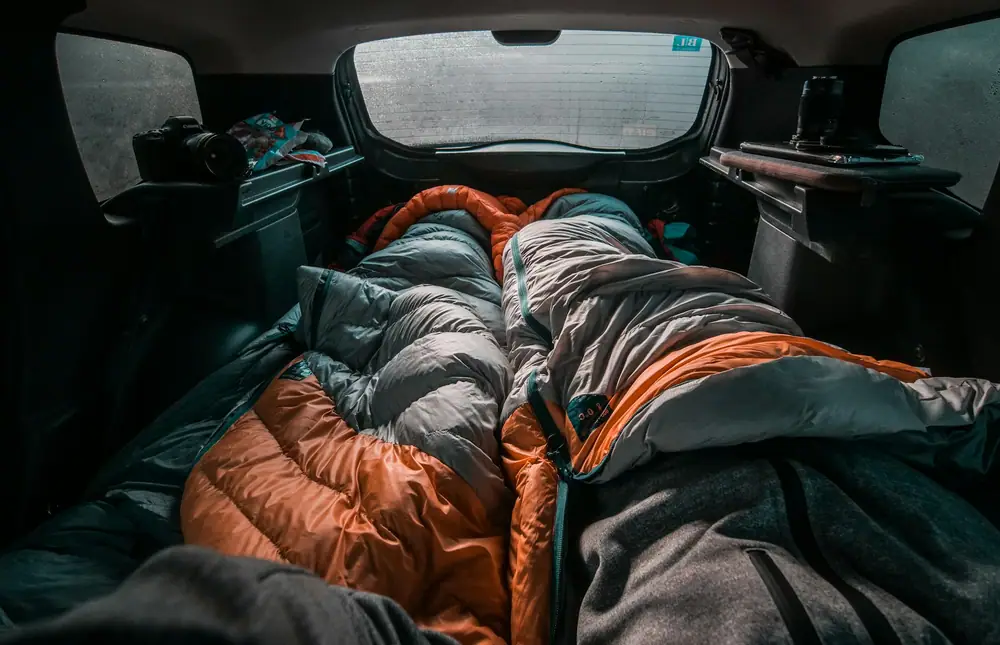
Your sleeping bag keeps the air off you. Your pad keeps the ground off you. On night one, the ground is usually winning.
Understanding bag ratings
Many sleeping bags list more than one temperature. A common standard gives a comfort rating, the temperature at which a typical cold sleeper should be comfortable, and a lower limit, the temperature at which a typical warm sleeper can sleep curled up. Marketing often puts the lower figure on the label. For a first trip, plan around the comfort rating and choose a bag rated a good margin below the overnight forecast.
Fit counts too. A bag much too big leaves air space your body has to heat. Pull the hood drawcord snug so only your face is exposed, and use the draft collar if the bag has one.
| Cause of cold | Fix |
|---|---|
| Thin pad or air mattress | Insulated pad; add a foam pad underneath |
| Bag rating too optimistic | Choose by comfort rating; add a liner |
| Damp clothes from the day | Change into dry sleep-only clothes |
| Going to bed hungry | Warm dinner and a snack before sleep |
| Cold head | Wear a warm hat; cinch the hood |
| Going to bed already chilled | A short brisk walk first, then straight into the bag |
Bedtime habits that help
- Change into dry clothes. Clothing worn all day holds sweat and moisture. Keep a set of base layers and socks only for sleeping.
- Eat before bed. Your body makes heat by digesting food. A warm dinner and a small snack with some fat in it help.
- Warm up first. Do not climb in already cold. A few minutes of walking or jumping jacks, then straight into the bag.
- Bathroom trip before bed. Your body uses energy keeping a full bladder warm, and a 3 a.m. trip lets heat out of the bag.
- Hot water bottle. Fill a sturdy, leak-proof bottle with hot water, close it tightly, wrap it in a sock and put it in the bag at your feet or core.
- Ventilate a little. A sealed tent collects moisture from your breath, and damp insulation is cold insulation. Leave the vents open.
Do not breathe into the bag
It is tempting to pull your face inside on a cold night, but your breath adds moisture to the insulation. Keep your nose and mouth outside and wear a hat or buff instead.
If you wake up cold
Add layers in this order: hat, then an extra top layer, then a puffy jacket laid over the top of your bag rather than worn inside it if space is tight. Eat a snack. Check that you have not slid off your pad; on a slight slope this happens more often than people think. If you are sharing a tent, moving pads closer together helps a little.
If you are shivering hard and cannot warm up, it is completely fine to sit in the car with the heater on for a while, or to call it a night and drive home. Comfort and safety come before sticking it out.
The short version
Good pad, bag chosen by its comfort rating, dry sleep clothes, food, a hat, and a little ventilation. Get those six right and your first night will likely feel very different from the stories you have heard. For the full packing list, see the first-night checklist and the weather prep checklist.
Print-friendly checklists
Turn this into action with our six beginner checklists, each with a print button.